Julius Raab
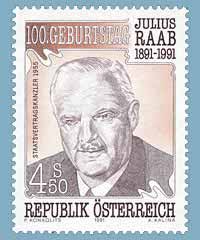 Julius Raab, the second Chancellor of the Second Republic, was born on 29th November 1891 at St. Pölten in Lower Austria. He was the son of Herr Julius Raab, a building contractor, and of his wife Franziske Wohlmeyer. The boy was educated at the grammar school attached to the Benedictine Abbey of Seitenstetten and at the Vienna Technical University. His studies in Vienna were interrupted by service as a lieutenant in the first World War. Upon his discharge in 1918, Mr. Raab returned to the Institute of Technology where he graduated in engineering in 1922. He had served throughout the First World War as a lieutenant in the infantry, with considerable distinction, and after that war became interested in politics as a student. Although, after graduation, he joined his father's business and even founded his own, he was elected to the lower House of Parliament in 1929 for his home constituency representing the Christian Socialist Party. He was thus active in the politics of the First Republic, being a member of the National Council from 1929 to 1934, of the Economic Council from 1934 to 1938. In January of 1938 he was appointed Minister of Trade and Communications in the last Austrian cabinet before the annexation of Austria by Germany. Julius Raab then withdrew completely from public life during the period of the Anschluss. From 1938 to 1945 the Nazis would not permit Dr. Raab to work in his own business, and he joined a road construction company. In this capacity, he fearlessly gave temporary refuge to many individuals who were persecuted by the Nazis. One of these people was Leopold Figl, who later became Austria's first post-war chancellor. After the liberation in 1945, Dr. Raab, as one of the founders of the Austrian People's Party, joined the first post-war cabinet and became Minister of Commerce under Chancellor Leopold Figl. On 1st April 1953 he succeeded as Chancellor and negotiated the State Treaty of 1955 by which the occupying powers withdrew from Austria which became a permanently neutral country. On 11th April 1961 he resigned as Chancellor but continued to be active in political life; standing as a candidate for the Presidency in 1963 but losing to Dr. Schärf. Dr. Raab died in Vienna on 8 January 1964, after a long illness. He is today honoured as the man most responsible for Austria's freedom. Dr. Figl said it best at his friend's funeral on 14 January 1964, that 'As long as the red-white-red flag flies over a free Austria, the name of Julius Raab will not be forgotten'. He has twice been honoured on Austrian postage stamps [ANK 1722, 2077], on 27 November 1981 and on 29 November 1991, on the occasion of what would have been his 100th birthday
(close this window when finished with)
©Andy Taylor. Last updated 2 Jan 2014